Best Vacuum Pump for Laboratory: Top Picks for Clean, Quiet, and Reliable Filtration
Choosing the right lab vacuum pump involves balancing oil-free operation, noise level, portability, and adjustable pressure. The following selections emphasize oil-free diaphragm pumps suitable for filtration, microanalysis, and general lab work. Each entry includes practical features to help maintain cleanliness and efficiency in American labs and classrooms.
| Product | Brand | Key Benefit | Approximate Flow | Notes |
|---|---|---|---|---|
| ScitoLAB Vacuum Pump 50 L/Min | ScitoLAB | Ultra-quiet, maintenance-free | 50 L/min | Switch on power cord; compact aluminum silencer |
| JOANLAB Laboratory Vacuum Pump VP-30L | JOANLAB | Oilless, versatile for filtration & air flow | 30 L/min | Positive/negative pressure; easy storage |
| WEST TUNE Lab Diaphragm Vacuum Pump | WEST TUNE | Quiet operation with nozzle noise reduction | 10 L/min | Two rubber tubes; compact and stable |
| GOYOJO Oilless Vacuum Pump | GOYOJO | High speed filtration with dual ports | 10–15 L/min | Oil-free; dual-port flow control |
| LACHOI Lab Vacuum Pump | LACHOI | Lightweight, clean operation | 15 L/min | Oil-free; metal handle; anti-slip feet |
ScitoLAB Vacuum Pump 50 L/Min Review

The ScitoLAB model operates oil-free and requires minimal maintenance. Its on/off switch reduces wear on the power cord, and the aluminum silencer lowers operational noise for a quieter lab environment. The pump’s compact design aligns with lab bench aesthetics while delivering up to 50 L/min for filtration, drying, and sample preparation tasks. Features emphasize reliability and a straightforward workflow, making it suitable for electronics, biological, and chemical labs seeking clean operation with less downtime.
JOANLAB VP-30L Oilless Vacuum Pump

JOANLAB’s VP-30L combines oil-free operation with a robust diaphragm pump. It’s designed for mixed-use in filtration and microanalysis, delivering reliable suction while minimizing oil contamination risks. The model emphasizes ease of maintenance, compact storage, and versatility—capable of both pumping and blowing air. Its positive and negative pressure capability suits laboratories performing varied filtration tasks, essential oil processing, and hobbyist applications, ensuring clean air pathways and a stable performance with long service life.
WEST TUNE Diaphragm Vacuum Pump Review
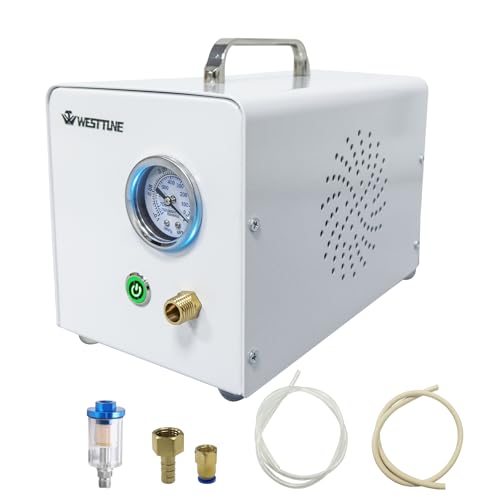
WEST TUNE offers a portable, oil-free diaphragm vacuum pump designed for quiet operation. With a 10 L/min flow rate and an integrated noise-reduction feature, this unit provides a balance between performance and comfort in small-scale lab setups. It’s well-suited for filtration tasks, microfluidics experiments, and education labs where space is at a premium and a low-noise environment is essential for collaboration and teaching.
GOYOJO Oilless Vacuum Pump Features

GOYOJO’s oil-free vacuum pump emphasizes clean operation and dual-port versatility, enabling both suction and blast air outputs. The 10–15 L/min range provides practical speed for rapid filtration and solvent handling without oil contamination risks. The unit’s compact form, durable construction, and quiet outlet design make it a practical choice for chemistry labs, biotech facilities, and educational labs seeking dependable performance with simple upkeep.
LACHOI Portable Oil-Free Lab Vacuum Pump

LACHOI’s portable oil-free pump focuses on clean, stable operation with a lightweight profile. It features a metal carrying handle, anti-slip feet, and cooling hole design for improved heat dissipation. The 15 L/min flow rate supports moderate filtration tasks, making it a good option for mobile labs, field work, and teaching labs that require a compact, oil-free solution with predictable performance.
Buying Guide: Key Purchase Considerations
- Oil-free design: Oil-free diaphragms reduce maintenance and prevent oil contamination, which is critical for cleanroom-like applications and sample integrity.
- Flow rate and pressure range: Match the pump’s maximum flow and whether you need positive, negative, or both pressures. Filtration and sample preparation often benefit from moderate flow (10–30 L/min).
- Noise level: Quiet operation improves lab morale and compliance with shared spaces. Look for built-in silencers or sound-dampening housings.
- Portability and footprint: Compact, lightweight units support benchtop setups and mobile labs. Consider rubber feet or isolation pads to reduce vibration.
- Maintenance needs: Oil-free models reduce upkeep. Check the availability of replacement diaphragms and seals and the ease of replacing filters.
- Durability and materials: Aluminum or metal housings often provide better heat dissipation and longevity for continuous use.
- Versatility: Some models offer dual ports or the ability to both pump and blow air, which broadens application coverage beyond simple filtration.
- Compatibility with accessories: Ensure compatible tubing sizes, adapters, and filters for your specific applications.
Additional Considerations: Depth Of Use
Laboratories vary widely in their requirements. For high-purity work, prioritize oil-free and easy-to-clean configurations. For educational settings, emphasize simplicity, portability, and cost-effectiveness. In industrial research, look for higher flow rates, robust construction, and stable long-term operation. Evaluate each model for reliability in environments with solvents, particulates, or humidity, and consider ordering spare parts in advance to minimize downtime.
Leave a Reply