Best Vacuum Pump for Filtration: Reliable Options for Lab Filtration and Beyond
Choosing a vacuum pump for filtration requires balancing cleanliness, efficiency, noise, and portability. The following selected models are oil-free or oil-less diaphragm pumps designed to minimize contamination while delivering solid filtration speeds. This guide highlights five proven options, comparing flow rates, pressures, and practical lab-friendly features to help you pick a pump that fits your filtration workload.
| Product | Brand | Flow Rate | Key Benefit |
|---|---|---|---|
| Oilless Vacuum Pump, 15L/Min | GOYOJO | 10-15 L/min | Dual pressure, compact and quiet |
| WEST TUNE Lab Diaphragm Vacuum Pump | WEST TUNE | 10 L/min | Oil-free, stable, low noise |
| LACHOI Lab Vacuum Pump Portable | LACHOI | 15 L/min | Oil-free, lightweight, portable |
| JOANLAB Laboratory Vacuum Filtration Pump | JOANLAB | 30 L/min | High flow, versatile for various applications |
| LAB FISH Lab Vacuum Pump | LAB FISH | 10 L/min | Oil-free, anti-slip base |
Oilless Vacuum Pump, 15L/Min With Dual Pressure

The GOYOJO model is designed for clean lab filtration with an oil-free diaphragm that operates without regular oil changes. It maintains a suction rate of 10-15 L per minute, significantly reducing filtration time compared to gravity methods. Dual ports enable both vacuum and air blowing, allowing precise flow adjustment to accommodate different liquids, solvents, and high-viscosity fluids. A compact, portable form weighs about five pounds, with four silicone pads and a noise-reducing outlet to minimize vibration and noise, supporting a stable workspace.
Oil-free operation reduces contamination risk in chemical research and other purity-sensitive environments. The pump’s robust construction targets long-term reliability, making it suitable for routine filtration tasks where sample integrity matters. Its balance of speed and control helps streamline workflows without introducing messy maintenance.
WEST TUNE Lab Diaphragm Vacuum Pump
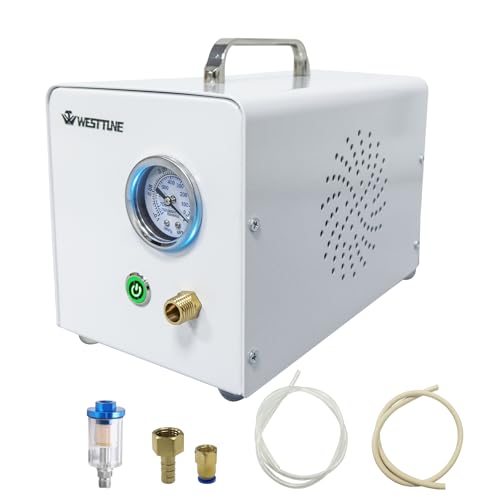
The WEST TUNE unit uses an oil-free diaphragm design rated at 0.08 MPa, eliminating oil treatment and monitoring. Operating at 10 L/min, it offers a fast filtration rate while reducing experimental time. The pump ships with features to stabilize operation: four silicone pads dampen vibrations, and a noise-reduction device on the outlet lowers sound levels for quiet lab work. The result is a cleaner environment with reliable performance for standard filtration tasks in research settings.
Designed for practical lab use, this model emphasizes stability and ease-of-use. The absence of oil simplifies maintenance, while the integrated low-noise design helps maintain a comfortable work atmosphere during longer sessions. The four-silicone-pad base helps anchor the unit on crowded benchtops, increasing overall workflow efficiency.
LACHOI Lab Vacuum Pump Portable Oilless Diaphragm

The LACHIOI model emphasizes high efficiency and cleanliness with a fully oil-free operation, ideal for processes requiring high cleanliness standards. It ensures stable operation across varying temperatures and humidity levels, thanks to a well-designed control system and quality materials. The pump includes a metal carrying handle and a compact form factor for easy transport. Cooling holes on each side promote better heat dissipation, while four rubber anti-slip feet keep the unit steady during use.
This pump is suited for laboratories that value portability without sacrificing performance. The oil-free design reduces maintenance and potential contamination, enabling safer handling of sensitive samples. Its lightweight design and stability features make it a practical pick for researchers moving between benches or rooms.
JOANLAB Laboratory Vacuum Filtration Pump

JOANLAB’s VP-30L model delivers a higher filtration throughput at 30 L/min, making it a strong choice for workflows demanding faster processing, such as high-sample-volume tests or essential oil and beverage pretreatment. It uses an oil-free motor, reducing contamination risk and simplifying maintenance. The pump is described as a versatile unit capable of both vacuum and blowing air, broadening its application across laboratory tasks beyond filtration, including sample preparation and solvent handling.
With a robust set of lab-quality materials, this pump prioritizes durability for years of use. The higher flow makes it suitable for larger filtration vessels or quicker testing cycles, though users should monitor heat generation during extended runs. The unit’s portability and integrated design support efficient lab setups, especially in shared facilities.
LAB FISH Lab Vacuum Pump 10L/min

LAB FISH emphasizes a true oil-free operation with a 10 L/min flow rate, designed to deliver fast filtration without oil-based contaminants. The unit highlights a clean, maintenance-light experience suitable for small to mid-sized filtration tasks. The anti-slip base design with four pads provides stable operation on busy benchtops, while the compact body supports easy storage and portability.
Customers value its balance of speed and cleanliness, particularly for essential oils or beverage filtration where avoiding oil contamination is critical. The pump’s straightforward design supports quick setup and reliable performance, making it a dependable option for routine lab filtration work and small-scale production trials.
Buying Guide: Key Purchase Considerations
When selecting a vacuum pump for filtration, consider these factors to align with your lab needs:
- Oil-free operation: Reduces contamination risk and minimizes maintenance, which is essential for purity-sensitive samples.
- Flow rate and pressure: Match the filtration vessel size and liquid viscosity. Higher L/min values accelerate filtration but require adequate cooling for extended runs.
- Noise and stability: Quiet operation and anti-slip bases improve usability in shared or busy lab spaces.
- Portability: Compact design and light weight help when moving between benches or rooms.
- Versatility: Some models support both vacuum and air blow or positive/negative pressure modes, enabling broader lab applications.
- Durability and materials: Look for robust housings and quality diaphragms to withstand routine lab use.
- Maintenance needs: Oil-free designs generally reduce routine servicing and replacements.
In practice, labs that perform frequent filtration of samples with varying viscosities benefit from mid-to-high flow options with reliable stability and low noise. For high-throughput environments, pumps offering 20 L/min or more can significantly cut processing time, provided cooling and power considerations are managed. Conversely, compact settings or education labs may prioritize portability and low maintenance over peak flow.
Other considerations include compatibility with filtration accessories (tubes, flasks, adapters) and the availability of spare parts or replacement diaphragms. Finally, ensure the pump’s wattage and power requirements fit your facility’s electrical infrastructure and safety standards.
Leave a Reply