Best Spreaders Beams for Lifting: Top Picks for Safe, Efficient Hoisting
Choosing the right spreader beam is essential for safe lifting of uneven or awkward loads. This guide reviews five leading spreader beam options and related beam accessories, highlighting capacities, materials, and key features to match American lifting standards and everyday job-site needs. Each option focuses on durability, ease of use, and versatility to help you select a beam that improves stability and reduces risk on site.
Summary at a glance:
- 4400 LBS 2 Ton Aluminum 6′ Lifting Spreader Beam — Aluminum, light weight, versatile sling options
- Vestil SBM-40 Steel Adjustable Spreader Beam — 78-inch length, 4,000 Lb capacity, dual/bail versatility
- 4400 LBS 2 Ton Aluminum 4′ Lifting Spreader Beam — Shorter aluminum beam, 4 ft length
- 4400 LBS 2 Ton Aluminum 2′ Lifting Spreader Beam — Compact 2 ft option with round sling bridle
- Vestil SBM-20-4 Steel Economy Spreader Beam — 48 inches, 2,000 Lb capacity, two swivel hooks
4400 LBS Aluminum 6′ Spreader Beam (2 Ton) With Sling Bridle
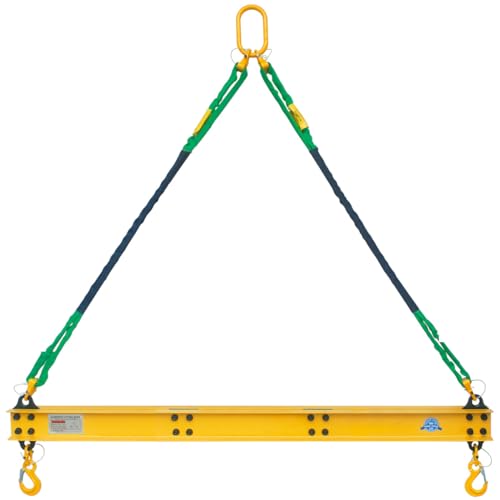
Material and capacity combine to offer a lightweight yet robust lifting solution. Made with aluminum alloy, this 6-foot spreader beam supports up to 4,400 pounds (2 tons). It ships with a 6-foot round sling bridle and G80 5/16-inch sling hooks, enabling immediate use. The design includes locking retaining pin web connectors that simplify assembly and disassembly, and allow changing sling lengths without tools. This balance of high capacity and low weight makes it suitable for quick setups on varied job sites while maintaining stability during lifts.
Vestil SBM-40 Steel Adjustable Spreader Beam, 78 In, 4,000 Lb

This steel beam offers robust performance for uneven or awkward loads. Its adjustable length spans 78 inches, with a 4,000-pound capacity. It complies with ASME B30.20-1993 standards and includes two lower bails plus one upper bail as standard, increasing versatility for different lifting configurations. The model is designed to provide stability across a range of dimensions, making it a practical choice for facilities that regularly handle irregular items or multiple load points.
4400 LBS Aluminum 4′ Spreader Beam (2 Ton) With Sling Bridle

This aluminum beam emphasizes weight savings without compromising capacity. A 4-foot spreader beam supports up to 4,400 pounds and comes with a 4-foot round sling bridle plus G80 5/16-inch sling hooks. Locking retaining pin web connectors enable simple assembly and disassembly, and the system supports changes in round sling lengths without tools. The combination of durability and ease of handling makes it well-suited for field use where quick turnarounds are essential.
4400 LBS Aluminum 2′ Spreader Beam (2 Ton) With Sling Bridle

This compact 2-foot aluminum spreader beam delivers high capacity in a short span. It features a 2-foot sling bridle and G80 5/16-inch sling hooks, designed for quick, tool-free assembly thanks to locking retaining pin web connectors. While small, it maintains the same robust aluminum construction and reliability, making it suitable for tight spaces where larger beams are impractical while still handling up to 4,400 pounds.
Vestil SBM-20-4 Steel Economy Spreader Beam, 48 In, 2,000 Lb

Designed for economical lifting of uneven and awkward loads, this 48-inch steel beam offers a 2,000-pound capacity. It meets ASME B30.20-1993 standards and includes two swivel lifting hooks for added versatility. This model is a practical option for facilities seeking a cost-effective solution that still adheres to recognized safety and performance standards for standard-height lifts and load coordination.
Vestil SBM-60-6 Steel Economy Spreader Beam, 72 In, 6,000 Lb

For heavier, larger load scenarios, this 72-inch steel beam supports up to 6,000 pounds. It complies with ASME B30.20-1993 standards and includes two swivel lifting hooks to accommodate various rigging configurations. The robust construction and generous capacity make it a strong option for applications where larger loads and extended reach are needed on the job site.
Vestil SBM-60-8 Steel Economy Spreader Beam, 96 In, 6,000 Lb

This 96-inch steel beam provides 6,000 pounds of capacity, with ASME B30.20-1993 compliance and two swivel lifting hooks. It’s designed for extended reach lifts where heavier or longer-load handling is required, offering dependable performance for industrial environments that demand consistent, safe load distribution.
Buying Guide: Key Purchase Considerations
- Material: Aluminum beams are lighter and easier to handle, ideal for frequent repositioning and field work. Steel beams offer maximum durability and higher static capacities, suitable for heavy, stationary lifts.
- Capacity: Match the load with a safety margin. If loads approach the upper limit, consider a beam with higher capacity or alternative rigging to maintain a safe working environment.
- Length and reach: Short beams excel in tight spaces; longer beams spread load over a greater area, reducing point stress. Select a length that fits your typical load geometry and hoist configuration.
- Accessories: Include slings, hooks (G80 rated), bails, and slings lengths. Locking retaining pins and web connectors simplify setup and reduce tool requirements on site.
- Standards and compliance: Look for ASME B30.20-1993 compliance or equivalent in your region to ensure safety and reliability for industrial use.
- Mounting versatility: Beams with multiple bail options or swivel hooks offer greater flexibility for uneven loads and multi-point lifting. Consider whether upper and lower bails are needed for your tasks.
- Portability vs. rigidity: Aluminum options are easier to move between sites, but steel beams may provide more consistent performance in high-use facilities. Evaluate your typical workflows and storage constraints.
- Maintenance: Check for corrosion resistance, especially in outdoor or marine environments. Proper inspection of hooks, slings, and pins reduces risk of failure during lifts.
When selecting a spreader beam, align the choice with your typical loads, work environment, and the expected frequency of reconfiguration. A balanced approach—combining capacity, weight, and ease of use—helps ensure efficient lifts while maintaining strict safety standards.
Leave a Reply