Best Smoke Evacuator for Laser Engraving and Soldering
When working with laser engravers, soldering stations, or other laser-powered tools, controlling fumes and particulates is essential for safety and comfort. The following hand-picked selections represent top-rated smoke extractors optimized for laser operations, soldering fumes, and small workshop environments. Each model offers strong filtration, adjustable airflow, and practical design for desktop setups. The list below highlights five options that balance suction power, filtration depth, noise levels, and ease of use to help you choose the right fit for your workspace.
| Product | Brand | Key Benefit |
|---|---|---|
| FumeClear FC-2002A Laser Fume Extractor | FUMECLEAR | 260 m³/h suction; 99.97% purification; replaceable pre-filters |
| KNOKOO FES150S Solder Fume Extractor | KNOKOO | 200 m³/h, 3-stage filtration, low-noise operation |
| KQZ 210W Laser Fume Extractor | KQZ | 330 m³/h, <50 dB, 3-layer filtration; high iodine carbon |
| OMTech 60W Fume Extractor | OMTech | 100 m³/h, dual-stage filtration; durable for laser and soldering |
| M-T Solder Fume Extractor | M-T | 243 m³/h, 4-stage filtration; versatile for various tools |
Note: The products listed below are selected for their relevance to laser engraving and soldering environments, focusing on filtration quality, suction capacity, and practical design for American workshops.
FumeClear FC-2002A Laser Fume Extractor

The FC-2002A model offers powerful suction up to 260 m³/h, designed to pull exhaust and fine particles from laser engraving and cutting processes within close range. Its 3-stage filtration system combines a pre-filter, HEPA, and a main carbon filter to deliver a 99.97% purification rate, reducing smoke, dust, and odors in the workspace. A robust carbon filter made from iodized coconut shell provides strong adsorption and long service life, and the unit ships with multiple pre-filters for extended use between changes. This configuration is well-suited for 10–20W laser engravers and soldering tasks, helping protect eyes and lungs while maintaining a comfortable environment.
Key considerations for this model include filter replacement intervals and noise performance at higher suction. The FC-2002A balances solid filtration with relatively low noise for its class, making it a practical choice for home shops and small studios. Practical compatibility with common desktop lasers makes it a versatile option for ongoing projects requiring frequent fume control.
Genmitsu Smoke Purifier for Kiosk Kortek Laser Cutter

This model emphasizes portability and a five-layer filtration system that targets fine particles and odors, delivering a cleaner air exchange within compact workspaces. Its design focuses on compatibility with kiosk-style laser machines and small-lot operations, while maintaining easy transport and setup. Three adjustable speeds enable users to tailor airflow to the job at hand, trading off filtration depth for quieter operation when needed.
For users who run longer engraving sessions or combine laser work with soldering tasks, the added filtration layers help manage odors and submicron particles. The purifier’s compact profile is ideal for desk setups, workbenches, or cabinetry environments where space is constrained but fume control remains essential.
KNOKOO FES150S Solder Fume Extractor

The KNOKOO unit employs a three-stage filtration system with a 3-layer core and a high-efficiency motor delivering up to 200 m³/h airflow. Its H13 HEPA and activated carbon filters capture fine PM0.3 particles and odors, improving air quality during soldering and laser work. The design supports cost efficiency through replaceable filter stages, allowing each layer to be serviced independently. With a compact footprint and low-noise operation, this model suits hobbyists and professionals seeking effective fume control without heavy equipment footprints.
Users should consider ongoing filter replacement costs and availability, as well as integration with the specific tools in use. The unit’s built-in filtration depth is strong for home workshops, labs, and small studios, where versatile application across soldering and laser tasks is common.
KQZ [Specialized] 210W Laser Fume Extractor

The KQZ 210W unit is engineered for high airflow—up to 330 m³/h—while maintaining quiet operation under 50 dB. Its three-layer filtration system targets smoke and odors with a filtration rate up to 99.97% for particles as small as 0.03 µm. A standout feature is the higher iodine content in the coconut shell activated carbon, which accelerates deodorization and improves overall air purification. The housing uses sound-damping materials to keep noise low during intense laser sessions, making it suitable for shared spaces and quieter workflows.
When selecting the KQZ system, consider the temperature tolerance of your laser environment and the potential need for additional ducting or setup space. The unit’s performance is particularly favorable for tasks generating significant smoke, such as certain fiber or CO2 laser engravers, where consistent airflow helps maintain a comfortable and healthy workspace.
Martians Fume Extractor for Soldering and Laser Work

This model emphasizes adjustable suction with a 10-foot exhaust pipe, extending the reach of fumes away from the immediate work area. The flexible gooseneck arm allows precise positioning for soldering and laser tasks, while the retractable ducting helps optimize airflow to outdoor venting or well-ventilated spaces. It is designed for multi-application use, including DIY projects, kitchens, and workshop environments that require portable air purification whenever soldering or laser work is performed.
Prospective buyers should assess the balance between portability and filtration depth. The available exhaust duct length and positioning flexibility make this unit attractive for spaces where static placement is impractical, though users should verify compatibility with their specific equipment and plug standards.
OMTech 60W Fume Extractor
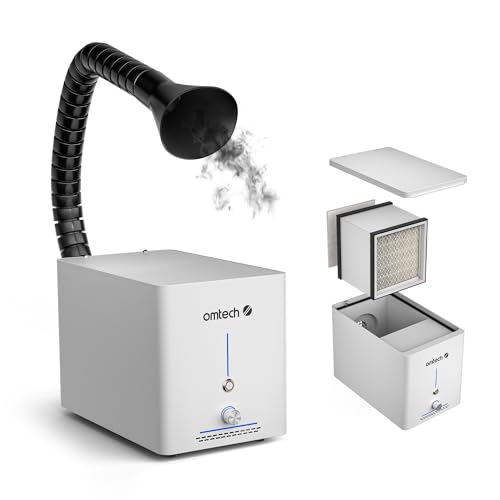
The OMTech unit is built for powerful smoke removal with a 60W motor and a maximum airflow of 100 m³/h. It employs a dual-stage filtration system: a primary cotton filter for larger particles, plus a HEPA and activated carbon layer to capture smaller particles and absorb fumes. This setup suits laser engraving, soldering, welding, and related tasks where a compact, dependable purifier is advantageous. While its airflow is lower than some competitors, its filtration complexity provides solid performance in small to mid-sized setups.
Air quality considerations for this model include whether its airflow is sufficient for your typical work pace and whether ducting or enclosure placement can maximize its effectiveness. It serves well in tight spaces where robust filtration is more critical than raw suction volume.
Buying Guide: Key Purchase Considerations And Comparisons
When choosing a smoke evacuator for laser work, consider these factors:
- Suction Power and Reach: Higher cubic meters per hour (m³/h) generally means faster removal of fumes from the immediate work area. Match airflow to your tool’s power and enclosure size.
- Filtration Quality: Look for a multi-stage system (pre-filter, HEPA, activated carbon) with a stated efficiency (e.g., 99.97% or higher at 0.3 µm). Activated carbon helps odor control in addition to particle capture.
- Filter Lifespan and Replacement Cost: Some models use iodized coconut shell carbon or specialized media. Check service life and replacement frequency to estimate ongoing costs.
- Noise Levels: For shared studios or home workshops, lower decibel levels improve comfort and compliance with nearby living spaces.
- Filtration Replacements and Availability: Accessibility of replacement filters affects long-term operating costs and downtime.
- Footprint and Portability: Compact units fit better on crowded benches, while portable purifiers are ideal for movable setups or job sites.
- Compatibility With Lasers: Ensure the unit’s temperature tolerance and ducting compatibility suit your laser’s exhaust setup and enclosure design.
- Maintenance and Access: Ease of cleaning and filter changing reduces downtime and encourages regular use, enhancing safety.
Comparison quick take:
- Best filtration depth: FumeClear FC-2002A and KQZ 210W models offer strong purification and higher filtration stage depth, suited for heavier smoke environments.
- Best for compact spaces: Genmitsu purifier and KNOKOO FES150S provide effective filtration in smaller footprints with adjustable speeds.
- Best for budget-friendly versatility: OMTech and M-T units provide reliable target filtration with decent airflow for mid-sized workshops and varied tasks.
- Best for adjustable reach: Martians model stands out for its flexible exhaust routing and portable positioning options.
In practice, the ideal choice depends on your laser wattage, enclosure design, and the frequency of use. For frequent 10–20W laser engraving or soldering, models with 260–330 m³/h suction and 99.97% filtration typically deliver the most consistent air-cleaning results, especially in rooms with limited ventilation. If noise is a primary concern, prioritize units with sound-damping housings and lower decibel ratings, even if they sacrifice a portion of suction power. Finally, plan for routine maintenance: stock replacement filters, verify compatibility with your equipment, and schedule regular service to sustain performance over time.
Leave a Reply