Best Load Cells for Weighing: Top Picks for Accurate Measurements
Choosing the right load cell is essential for precise weight measurement in projects ranging from DIY scales to industrial systems. The following hand-picked options cover a variety of capacities, protections, and signal outputs to suit different applications, from kitchen scales to high-precision industrial weighers. Each product features reliable materials, compatibility with popular amplifiers, and clear output signals to ensure dependable readings across environments.
| Product | Brand | Capacity | Notes |
|---|---|---|---|
| ShangHJ 4 Sets Digital Load Cell Weight Sensor | NC | 5 kg | HX711-ready for Arduino/Raspberry Pi |
| Load Cell 2000 KG Shear Beam | Yanmis | 2000 kg | IP67 protection |
| Portable S-type Beam Load Cell | Walfront | 2000 kg | Analog output |
| uxcell 500 g Wired Load Cell | uxcell | 500 g | Aluminum, corrosion-resistant |
| Wishiot 50 kg Load Cell With Bracket | Wishiot | 50 kg | Bracketed for mounting |
ShangHJ 5 kg Digital Load Cell Kit With HX711

The ShangHJ kit includes a 5 kg load cell paired with an HX711 ADC module, designed for Arduino and Raspberry Pi projects. It provides a direct voltage output that changes with force, requiring a 5–10V drive voltage. The four-lead load cell connects as E+ E- A+ A-, simplifying integration into DIY scales, kitchen counters, or portable weighing devices. This option is especially practical for hobbyists who want immediate signal processing compatibility and straightforward wiring for quick results.
Yanmis 2000 KG Shear Beam Load Cell
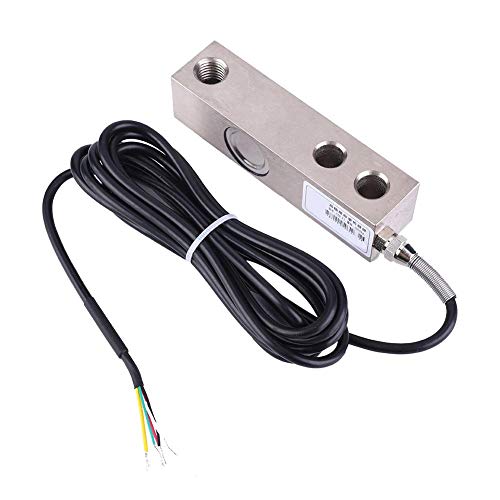
This high-capacity shear beam load cell uses alloy steel with protective coating to resist wear and corrosion. It is designed for robust weighing applications requiring IP67 sealing, making it suitable for environments with moisture or dust exposure. The 2000 kg capacity supports heavy weighing tasks, including industrial scales and large inventory systems, while maintaining reliable accuracy under demanding conditions. Its rugged build is ideal for scale manufacturers and integrators seeking durable, long-life components.
Walfront 2000 kg Portable S-Type Load Cell

The Walfront S-type load cell offers a high-accuracy analog output for tension or compression measurements. Designed for portable or mounted scales, its solid construction supports heavy-duty applications while providing straightforward signal data for custom weigh systems. The device is well-suited for hopper scales, bulk materials weighing, and field deployments where a reliable, traffic-resistant sensor is needed.
uxcell 500 g Aluminum Load Cell

This 500 g aluminum load cell is designed for compact, high-precision scales. It features anodized surfaces for durability and corrosion resistance, as well as a protective silica gel layer to guard against moisture and aging. Its simple structure aids easy installation, making it a good choice for kitchen scales, jewelry scales, or control systems where space is at a premium and accuracy matters.
Wishiot 50 kg Load Cell With Bracket

The Wishiot 50 kg load cell includes mounting feet and brackets to ensure steady placement and minimize measurement errors due to slipping. Its compact footprint (approximately 30 × 25 × 13 mm) makes it adaptable for small-scale installations while allowing multiple units to be combined for higher capacity readings. This configuration suits laboratory benches, bench scales, and custom weighing systems that require modular, repeatable measurements.
Buying Guide: Key Purchase Considerations
- Capacity: Determine the weight range you need to weigh. High-capacity load cells reduce the risk of overload but may be less sensitive at light weights. For hobby projects, 0.5–5 kg sensors are common; for industrial uses, 1–2000 kg or more is typical.
- Output Type: Analog vs digital. Analog outputs (mV/V) require amplifiers like HX711 for interpretation, while digital interfaces (RS-485, 4-20 mA, 0-5 V) provide easier integration with fewer external components. Choose based on your control system compatibility.
- Protection Rating: IP ratings indicate protection against dust and water. IP67 or higher is preferred for harsh environments or outdoor or moisture-prone settings.
- Material and Durability: Alloy steel or stainless steel offer durability and resilience under heavy use. Aluminum is lighter and suitable for lighter loads with good corrosion resistance.
- Mounting and Form Factor: Consider whether you need a bracket, feet, or a S-type/H-beam configuration. Brackets and mounting hardware improve stability and repeatability, especially in vibrating or dynamic systems.
- Electrical Compatibility: Ensure your amplifier or controller supports the load cell’s output format and voltage range. Check signal-to-noise characteristics and calibration requirements for accurate readings.
- Environment and Application: For kitchen scales, compact size and corrosion resistance matter. For industrial systems, reliability, ingress protection, and redundancy may be more important.
- Calibration and Maintenance: Look for devices with straightforward calibration processes. Regular checks and proper tightening of mounting screws help maintain precision.
In selecting load cells, balance your sensing accuracy, environmental conditions, and integration complexity. The listed options span from compact, beginner-friendly kits to rugged, high-capacity sensors suitable for demanding industrial applications, giving you a range to compare features, outputs, and mounting possibilities.
Leave a Reply