Best Bus Carts for Restaurants to Improve Efficiency
Choosing the right bus cart for a busy restaurant can streamline bussing, wait times, and overall service flow. The following selections combine high weight capacities, durable materials, and smooth mobility to perform in commercial kitchens and dining areas. Each option is designed to resist rust and withstand daily wear while allowing easy maneuverability through crowded spaces.
| Product | Brand | Capacity | Notable Feature |
|---|---|---|---|
| Carlisle Bussing Cart | Carlisle FoodService Products | 300 lbs | Omnidirectional casters for easy flooring navigation |
| WDT Heavy-Duty Cart | WDT | 990 lbs | Industrial-grade metal with anti-rust chrome plating |
| PELOEMNS 3-Tier Cart | PELOEMNS | 510 lbs | Four swivel wheels with brakes |
| ABACAD Large Cart | ABACAD | 390 lbs | Lockable wheels and anti-rust aluminum legs |
| MAYNIYJK 3-Tier Cart | MAYNIYJK | 420 lbs | Lockable wheels with sturdy aluminum/PP construction |
Carlisle Bussing Cart With Omnidirectional Casters

The Carlisle Bussing Cart features three textured shelves that enable efficient organization of bus boxes on each level. With four omnidirectional casters, it glides across kitchens, dining floors, and service corridors. The cart is built to support up to 300 pounds, making it capable of transporting multiple dishes or bus boxes per trip. This model emphasizes stability and ease of cleaning, helping staff move quickly between service zones.
WDT 990Lbs Capacity Heavy Duty Cart
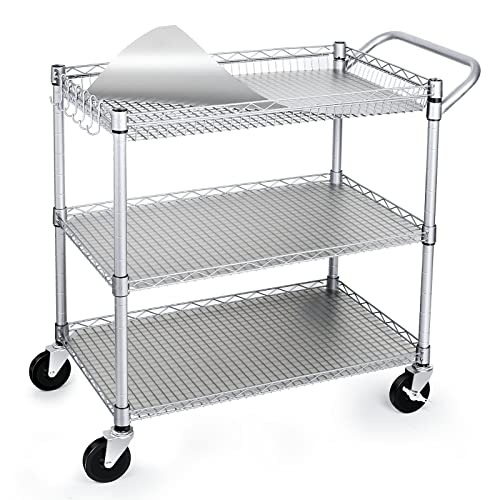
This cart stands out with a remarkable 990-pound capacity, making it suitable for heavy loads such as stacked bus boxes or bulk supplies. Constructed from industrial-strength metal with anti-rust chrome plating, it resists corrosion and simplifies cleaning. It includes a push handle, a ventilated basket, shelving liners, and hooks. Four silent casters enable smooth movement, while two fixed wheels provide stability when parked. The design focuses on durability and practical mobility for high-traffic restaurant environments.
PELOEMNS 3-Tier Utility Cart

PELOEMNS offers a 510-pound capacity across three spacious shelves, designed to haul catering equipment, boxes, and tools. The cart uses aluminum uprights and polypropylene shelves that resist scratches and rust, maintaining a like-new appearance. Four swiveling wheels, with two brakes, provide controlled movement and stability. The backboard and front design allow easy loading and unloading, making it adaptable for kitchen line prep or back-of-house transport.
ABACAD Large Plastic Utility Cart

The ABACAD large cart emphasizes practical design with lockable wheels and anti-rust aluminum legs. Each tray can hold up to 130 pounds, totaling a 390-pound capacity. Handles on both sides enable easy pushing, and the swiveling casters operate quietly. The open tray design supports quick access during service, while the overall build suits restaurant back-of-house tasks, garages, and workshops where mobility and reliability are essential.
MAYNIYJK 3-Tier Utility Cart

The MAYNIYJK cart provides three tiers and a robust 420-pound total capacity. It uses aluminum tubes and polypropylene shelves to combine strength with light weight. Four universal wheels, two of which are lockable, enable smooth operation on various surfaces. The design accommodates heavy items and multiple loads, making it suitable for kitchens, warehouses, and dining areas where mobility and stability are critical.
Buying Guide
- Weight capacity: Determine typical loads to select a cart with an appropriate total and per-shelf capacity, plus a sturdy frame to prevent tipping.
- Durability and materials: Look for anti-rust finishes, corrosion-resistant components, and easy-to-clean surfaces that survive frequent cleaning and exposure to moisture.
- Mobility: Consider caster type (swivel vs. fixed), wheel locks, and overall maneuverability on your floors (tile, concrete, or carpet).
- Dimensions: Ensure the cart fits through doorways, into storage, and under counters without obstructing workflow.
- Security features: Lockable wheels or additional safety features help prevent unintended movement in busy service areas.
- Maintenance: Favor designs with modular shelves and simple replacements for casters or rails to extend the cart’s usable life.
- Versatility: A three-tier or multi-tier configuration can accommodate different item sizes, from bus boxes to cookware and cleaning supplies.
- Cost of ownership: Balance initial cost with expected lifespan, warranty terms, and the potential need for accessories like liners or bumpers.
These options collectively address common restaurant scenarios: bussing tables, transporting bus boxes, stocking back-of-house stations, and moving supplies between kitchen and dining areas. For spaces with narrow aisles, choosing a compact, high-capacity cart with smooth wheels is advantageous. For larger kitchens and busy buffets, higher capacities with sturdy frames and reliable braking systems deliver consistent service.
Leave a Reply