Best 4th Axis Rotary Tables for CNC: Top Models for Precision Milling
Choosing a reliable 4th axis rotary table can expand your CNC milling capabilities, enabling complex curves, engraving, and multi-axis symmetry. Below are five well-regarded options designed for hobbyist to professional setups, with features like backlash reduction, waterproof motors, multiple axis configurations, and sturdy housings. Each entry is evaluated for compatibility with common CNC routers and engraving machines to help you compare performance and value.
Summary of selected products:
- CNCTOPBAOS Rotation 5th Axis Rotary Table with Waterproof Nema23 Motors — 50:1 reductions on A and C axes.
- CNC Milling Machine Rotational Axis K11-65mm 4th Axis — 4:1 reduction with a 63mm chuck.
- CNCTOPBAOS K12-100mm CNC Router Rotary Table — 6:1 reduction, 100mm chuck, MT2 tailstock.
- CNCTOPBAOS TRNC3M-A8-C6 5-Axis Rotary Table — 8:1 A/B and 6:1 C axis reduction, 100mm chuck.
- Genmitsu 4th Axis Rotary Module — Planetary geared stepper, compatible with 4040/3030 series, 10-200mm clamping range.
CNCTOPBAOS Rotation 5th Axis Rotary Table

The CNCTOPBAOS 5th Axis Rotary Table combines a 4th A axis and a 5th C axis with 50:1 speed reductions, enabling intricate multi-axis milling and engraving tasks. It uses two waterproof Nema23 stepper motors, designed to minimize vibration and noise while maintaining steady torque. The compact housing has a center height of 73mm and a bench diameter of 60mm, making it suitable for smaller CNC routers and engraving machines that require robust rigidity. The 8mm shaft and 4-wire leads support reliable stepper control, with a total height of 115mm for flexible mounting. This unit emphasizes durability with metal construction and a reduced risk of overheating through copper enamel insulation.
Key features include: 50:1 reductions for both A and C axes, waterproof motor design for safer operation, and a compact footprint that fits a range of machines. Applications span engraving, precise contouring, and complex part fabrication. Consider compatibility with your controller, required software for multi-axis synchronization, and the need for appropriate wiring for 2-phase stepper motors.
CNCTOPBAOS K11-65mm 4th Axis with 4:1 Reduction

The K11-65mm 4th Axis by CNCTOPBAOS combines a 4:1 belt-reduction system with a 63mm chuck. Its design centers around a compact form factor and clear dimensioning: middle height around 54mm, total height about 85mm. The three-jaw chuck offers straightforward clamping for a range of workpieces, from cylinders to circular features, while the MT2 tailstock enhances alignment and stability for longer turning operations. The unit is compatible with CNC routers, milling machines, and engraving machines, expanding practical 3+1 or 4-axis workflows.
Highlights include: a rigid aluminum base, precise centering with 0.05mm tolerance, and a tailstock that supports longer, complex work. When evaluating, consider the maximum clamping range, the stiffness of the tailstock, and how well the reduction ratio integrates with your controller’s stepping sequence and motion planner.
CNCTOPBAOS K12-100mm 4th Axis with 6:1 Reduction

This CNCTOPBAOS 4th Axis model features a 6:1 reduction, a 100mm chuck, and a MT2 tailstock. The 65mm center height and 115mm overall height balance compactness with sufficient reach for longer workpieces. The kit includes a 57x57x76mm Nema23 hybrid motor rated at 3A and 270 oz-in torque, with 8mm shaft diameter. The 4-piece wiring harness uses a standard color code to connect A and B channels to the driver, enabling predictable and repeatable indexing. A robust aluminum base and precise tolerances support stable operation in milling and engraving tasks.
When choosing this model, consider the rigidity of the tailstock and the maximum clamping range (22-30mm output shaft parameters), as well as the compatibility of your controller with 6:1 gearing. The combination is well suited for projects needing repeatable positional accuracy across multiple axes.
CNCTOPBAOS TRNC3M-A8-C6 5-Axis Rotary Table

The TRNC3M-A8-C6 model is a high-end 5-axis rotary table with a 100mm chuck and a multi-axis indexing capability. It supports A and B axis ranges up to ±90° and a C axis rotation of 0-360°, accompanied by a 8:1 reduction for the A/B axes and 6:1 for the C axis. Its Nema23 stepper motor ensures solid torque, while a 100mm table footprint helps accommodate larger parts. The unit uses a robust aluminum frame and a hollow shaft for through-workpiece access, which is advantageous in milling and engraving scenarios where chip evacuation and repeated orientation changes are necessary.
Consider if your CNC controller, offline controller support, and software wiring can handle the multi-axis synchronization required for true 5-axis operations. Also assess wheel-based mounting options and the availability of tailstock adjustments for extended workholding flexibility.
CNCTOPBAOS K11-80mm Hollow Shaft 4th Axis
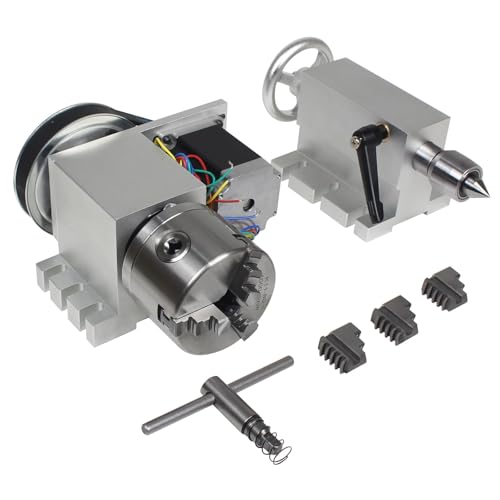
The K11-80mm Hollow Shaft configuration combines a 6:1 reduction with 65mm tailstock and 115mm overall height. The hollow shaft design is advantageous when through-holding is needed, enabling longer workpieces to extend through the axis. The 270 oz-in torque, 3A current, and 8mm shaft diameter align with typical CNC drivers in hobbyist and professional setups. A 6:1 reduction helps balance torque and speed for reliable indexing and turning operations. The MT2 tailstock adds support for longer cylinders and threaded components, increasing stability during heavy cuts.
Evaluation considerations include the balance between axial rigidity and vibration damping, the compatibility of the 16-22mm through-hole with your workpieces, and the ease of mounting and aligning the tailstock for repeatable accuracy across sessions.
Buying Guide: Key Purchase Considerations for 4th Axis Rotary Tables
- Axis configuration and complexity: Decide whether you need just a 4th axis for simple indexing, or a full 5-axis arrangement with additional A/B and C rotations. Multi-axis setups demand compatible controllers and software capable of coordinated motion.
- Reduction ratio and torque: Higher gear reductions (e.g., 6:1 or 8:1) boost torque for heavy cuts but may reduce speed. Consider your typical workpiece size and material to pick an appropriate balance.
- Motor type and sealing: Waterproof or sealed motors help with dust and coolant exposure in certain environments. Ensure the motor and gearbox materials (metal housings, copper windings) support long-term reliability.
- Jaw chuck size and tailstock: A larger chuck (e.g., 100 mm) accommodates bigger parts, while tailstocks (MT2 or MT3) provide added support for longer workpieces. Check clamping ranges and centering precision.
- Through-hole and hollow shaft: Through-holes enable longer parts to pass through the axis, reducing the need for secondary gripping devices and improving alignment during machining.
- Compatibility and wiring: Confirm that your CNC controller and driver boards support the motor wiring (2-phase Nema23, 3-phase equivalents) and that wiring color codes match your setup for straightforward integration.
- Software integration: For 5-axis indexing, ensure your CAM software can generate accurate multi-axis toolpaths and that an offline controller can be used where necessary to manage complex G-code streams.
- Physical footprint and mounting: Compare center height, total height, and base dimensions to your machine bed. Ensure there are compatible mounting holes and clearances for toolpaths and spindles.
- Maintenance and support: Look for models with readily available spare parts, documented maintenance steps, and responsive seller support to minimize downtime during projects.
- Price-to-performance: Higher-end modules offer better precision and durability but review whether the added capability aligns with your project needs and budget.
Overall, these 4th axis products provide a spectrum from compact hobbyist units to more capable multi-axis systems. When choosing, prioritize compatibility with your existing CNC hardware, the range of motion required, and how the gearing and motors will influence cutting performance and part accuracy across the intended tasks.
Leave a Reply