Best 3D Scanners for Reverse Engineering: Precision Tools for Accurate Digital Replication
For engineers, designers, and makers, selecting a reliable 3D scanner is essential for accurate reverse engineering. The following devices offer metrology-grade accuracy, fast capture rates, and versatile scanning modes designed to handle a range of materials and object sizes. This guide highlights five top options to help you choose a scanner that fits industrial tasks, hobby projects, and quick prototyping alike.
Summary of Selected Products
- Revopoint MetroX 3D Scanner — Industrial-grade blue laser, up to 60 fps, metrology precision
- Revopoint MIRACO Plus 3D Scanner — Photogrammetric metrology, high-accuracy calibration, full-color capture
- Creality Raptor Pro 3D Scanner — Metrology-grade accuracy, dual blue laser mode, NIR structured light
- Creality Otter Lite Basic 3D Scanner — High-precision 0.05 mm, color texture, portable
- Revopoint POP3 Plus 3D Scanner — 0.04 mm precision, fast scanning, full-color capture
Revopoint MetroX 3D Scanner

The MetroX uses an industrial-grade blue laser system to deliver high-precision scans suitable for metal parts, molds, and other challenging surfaces. It offers a precision target of up to 0.01 mm with a fused point cloud distance near 0.05 mm, enabling reliable metrology-grade measurements. Four scanning modes—including Cross Lines, Parallel Lines, Full-field, and Auto Turntable—support diverse object types and automate workflows. It can scan dark or shiny surfaces without masking spray, thanks to GPU-accelerated blue laser lines reaching up to 60 fps, provided the GPU is compatible.
Key features include a 0.02 mm accuracy capability and a fast Full-field mode capturing millions of points per second. The device is designed for industrial measurement and quality control environments, with attention to safe operation around the blue laser. Its versatility makes it suitable for reverse engineering tasks that demand both detail and speed, from mechanical parts to tooling models.
Revopoint MIRACO Plus 3D Scanner

The MIRACO Plus combines photogrammetry with a quad-depth camera system, delivering high-resolution color scans for both small components and large assemblies. It includes a calibration package with carbon fiber scale bars and coded targets to boost length accuracy to 0.02 mm plus a positional tolerance of 0.05 mm x L(m). The 48 MP RGB camera and infrared lighting produce photorealistic color textures for lifelike models, while a 20% improvement in single-point cloud accuracy helps ensure reliable reverse-engineering data. Safe infrared laser technology enables direct face scans with minimal risk.
With versatile modes and Near/Far depth capabilities, the MIRACO Plus supports a broad range of object sizes and surface textures. For reverse engineering workflows, its ability to capture texture, color, and geometry in a single pass reduces the need for post-processing and enables quick comparisons against CAD models.
Creality Raptor Pro 3D Scanner

The Raptor Pro targets metrology-grade accuracy with up to 0.02 mm precision plus 0.08 mm/m volume accuracy, aided by an upgraded dual blue laser mode (22+7 lines) for efficient coverage of medium to large objects. It includes 7 laser lines for partial HD scanning and uses NIR structured light to enhance feature detection on complex surfaces. The scanner can handle a variety of parts, from automotive components to mechanical assemblies, and is designed for reverse engineering and industrial inspection.
Key strengths include fast scan speeds of up to 660,000 points per second and a wireless data pathway via Wi-Fi 6 for convenient, real-time data transfer. The Raptor Pro’s combination of blue laser and NIR structured light provides robust performance on reflective or dark surfaces, reducing the need for frequent surface preparation.
Creality Otter Lite Basic 3D Scanner

The Otter Lite Basic delivers a balance of portability and performance with 0.05 mm resolution and dual-mode scanning for close-range and long-range objects. It supports full-color texture capture and offers convenient export formats (OBJ, STL, PLY) for integration with CAD and 3D printing pipelines. Lightweight at about a quarter of a kilogram, the Otter Lite is well-suited for field work and quick reverse-engineering tasks where portability matters.
For practical use, its RGB and infrared cameras enable color texture mapping, making it easy to compare captured models to reference designs. The included accessories—a turntable, calibration board, markers, and carrying case—enhance setup efficiency and repeatable scans in varied environments.
Revopoint POP3 Plus 3D Scanner
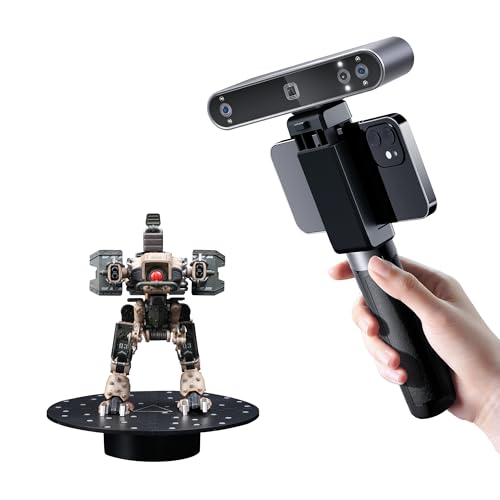
The POP3 Plus emphasizes refined precision and color capture, delivering 0.04 mm accuracy with fast speeds. Its calibrated projector and optical zoom (1.5x and 2x) provide up to 30% more point cloud detail, enabling faithful digital replicas of moderately sized objects. The scanner supports full-color scans with a high-definition RGB camera and Flash LED lighting to ensure perceptually accurate textures. A 9-axis IMU helps stabilize scans, reducing the impact of motion or vibrations during handheld use.
Designed for versatility, the POP3 Plus performs well on a range of objects from small mechanical components to larger artifacts. The combination of speed, color fidelity, and portable form factor makes it a strong option for reverse engineering workflows that require quick turnarounds and reliable data capture for CAD comparison and feature extraction.
Buying Guide: Key Purchase Considerations
When choosing a 3D scanner for reverse engineering, consider the following factors to align with your workflow and budgets:
- Accuracy and resolution: Metrology-grade scanners (0.02 mm or better) are preferred for precise measurements and feature capture on mechanical parts.
- Surface handling: Blue laser and NIR options improve performance on dark, shiny, or reflective surfaces—important for metal parts and polished objects.
- Lighting and color: Full-color texture capture is valuable for visual references and CAD texture mapping, especially when comparing finishes or applying textures in downstream software.
- Scan speed and workflow: High fps and efficient modes reduce capture time and post-processing. Auto Turntable and multi-mode systems can automate portions of the process.
- Portability vs. stationarity: Handheld scanners offer flexibility, while desktop or turntable-based solutions maximize repeatability and accuracy in controlled settings.
- Data compatibility: Look for widely supported export formats (OBJ, STL, PLY, STEP) and reliable software integration with CAD tools.
- Safety and maintenance: Some devices use Class 2M or similar lasers; follow safety guidelines and ensure proper handling to avoid exposure risks.
- System requirements: Check GPU compatibility for GPU-accelerated scanning modes and ensure your computer meets recommended specs for smooth capture and processing.
Balance these factors against your typical reverse engineering tasks—whether you scan automotive parts, machinery housings, or custom prototypes. For field work, portability and quick capture are crucial; for factory-quality measurements, metrology-grade accuracy and repeatability take precedence. Consider a device that offers multiple modes and robust color/color-texture capabilities to maximize data usability across CAD workflows.
Leave a Reply