Best 3D Scanners for Industrial Use: High-Precision Picks for Manufacturing
For industrial applications, choosing a 3D scanner involves balancing precision, speed, surface compatibility, and workflow compatibility. The following selections emphasize metrology-grade accuracy, robust scanning modes, and reliable performance on challenging parts like metals, molds, and machinery. Each option is suited for quality control, reverse engineering, and rapid prototyping in demanding environments.
| Product | Brand | Type | Key Strengths |
|---|---|---|---|
| Revopoint MetroX 3D Scanner (Industrial-Grade) | Revopoint | Handheld with blue laser | 0.01 mm precision, 60 fps, dark/shiny surface capability |
| Revopoint MIRACO Pro Wireless | Revopoint | All-in-one handheld | 0.02 mm precision, full-color, wireless on-board processing |
| Creality RaptorX 3D Scanner | Creality | Hybrid blue laser & NIR | 0.02 mm accuracy, multiple light sources, wireless mobility |
| Revopoint POP3 Plus | Revopoint | Handheld with infrared color capture | 0.04 mm precision, full-color, fast scanning |
| 3DMakerpro 3D Scanner | 3DMakerpro | Handheld | 0.05 mm accuracy, 10 fps, mobile-friendly |
Revopoint MetroX 3D Scanner — Industrial-Grade Blue Laser

MetroX offers industrial-grade blue laser scanning with accuracy up to 0.02 mm and precision to 0.01 mm, suitable for high-precision measurement and quality control of metal parts. It supports multiple scanning modes, including Full-field and Auto Turntable, enabling metrology-grade workflows. The device uses 14 blue laser lines to efficiently scan dark or shiny surfaces at up to 60 fps, minimizing the need for spray while balancing GPU-accelerated processing. Users should avoid direct exposure to the light source at close range due to Class 2M laser projection.
Its four scanning modes adapt to diverse objects: Cross Lines, Parallel Lines, Full-field for rapid captures, and Auto Turntable for automated metrology-scans. This makes MetroX well-suited for tooling, molds, mechanical parts, and industrial inspection tasks where fast, repeatable scans are critical. While it emphasizes precision, compatibility with Windows and macOS ensures broad integration into existing QA pipelines.
Revopoint MetroX 3D Scanner — Standard Version

The MetroX Standard edition mirrors the industrial-grade capabilities with essential accuracy and speed. It emphasizes stable data capture, reliable metrology-grade scanning for manufacturing parts, and efficient handling of challenging surfaces via its blue laser system. The standard configuration supports the same mode versatility and GPU-assisted performance, suitable for shop-floor inspection and tooling validation in production lines.
Revopoint MIRACO Plus — Wireless 3D Scanner

MIRACO Plus concentrates on full-color, photorealistic scanning with all-in-one handheld operation. Its 32GB RAM assures ample on-device processing, enabling high-detail color models for small-to-large objects. The quad-depth camera system covers Near and Far modes to capture both fine features and broad surfaces, making it suitable for part cataloging, assembly verification, and color-accurate inspection tasks in industrial contexts that require quick turnarounds and on-site scanning.
Revopoint MIRACO Pro Wireless — All-in-One

The MIRACO Pro extends the wireless, on-board processing concept with a quad-depth camera array enabling flexible scanning from tiny screws to large machinery. It supports full-color capture and 0.02 mm frame precision, catering to workflows that demand mobile, on-site evaluation without external hardware. This model is well-suited for rapid prototyping, field QA, and design validation where color fidelity and model detail are essential.
Creality RaptorX 3D Scanner — Hybrid Blue Laser & NIR

RaptorX combines blue laser and infrared scanning with a maximum accuracy around 0.02 mm, supporting cross-laser, parallel-laser, and infrared modes. This versatility helps optimize scans for diverse materials and complex geometries. The wireless handheld design enables mobility around large parts, reducing the need for additional fixtures in a shop environment. Its three-source approach supports robust metrology workflows, mold recreation, and assembly validation across manufacturing lines.
3DMakerpro 3D Scanner — Moose Lite Advanced

3DMakerpro’s Moose Lite Advanced focuses on practical handheld scanning with 0.05 mm accuracy and 10 fps speed, suitable for mid-size industrial components and assemblies where portability matters. It supports multiple operating systems and emphasizes straightforward workflow integration. While not the highest-precision option in this list, it provides a reliable balance of cost, portability, and acceptable detail for certain production QA tasks and quick reverse-engineering projects.
Revopoint POP3 Plus — Full-Color, High-Detail
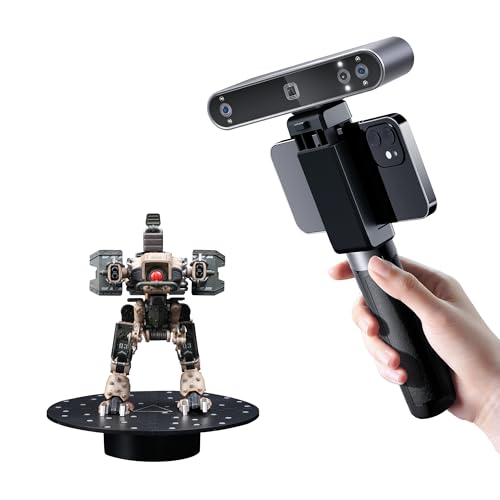
POP3 Plus enhances precision by about 20% over earlier models, offering 0.04 mm accuracy and improved point detail via an updated calibration board and optical zoom (1.5x and 2x). It supports full-color scans with an HD RGB camera and Flash LED lighting, enabling lifelike representations of medium-sized objects. The 9-axis IMU aids scan stability, making it a practical choice for on-site inspections, product validation, and rapid color-accurate modeling in industrial settings.
Buying Guide
- Precision vs. object size: Higher precision (0.01–0.02 mm) benefits small, high-tolerance parts; for large assemblies, slightly lower precision may still meet QA needs if combined with post-processing.
- Surface compatibility: Blue laser and infrared options handle metals and dark surfaces differently. Consider spray or coatings only if surface color or reflectivity hampers scans.
- Color capability: If texture/color data matters for downstream processes, prioritize full-color scanning models with robust RGB capture.
- Ease of workflow: On-board processing, wireless operation, and auto-turntable features can reduce setup time on busy shop floors.
- Software integration: Check compatibility with CAD/inspection software and file formats (OBJ, STL, PLY, etc.).
- Portability: Wireless handheld models improve mobility around large objects; ensure battery life aligns with scanning sessions.
- Safety: Review laser class and eye-safety notices, especially in environments with workers present.
- Future-proofing: Consider models with software updates, support, and a path to higher-precision capabilities if requirements evolve.
Leave a Reply